Editorial
DOI:
https://doi.org/10.33683/ddm.22.11.0Abstract
«The theory of argumentation rejects overly clear antitheses: it shows that between absolute truth and non-truth there is room for truths to be subjected to continuous revision thanks to the technique of adducing reasons for and against. It knows that when men stop believing in good reasons, violence begins».
(Bobbio, 2013, foreword to Perelman & Olbrecht-Tyteca, 1958/2013, XIX, translated by the author)
As Norberto Bobbio states in the proposed quotation, «when men stop believing in good reasons, violence [unfortunately] begins».
This sentence, in the complex and difficult current world context, reminds us of the importance of those transversal competences which are nowadays covered in all school curricula: learning to communicate and argue, understanding and accepting the point of view of others, being able to listen and collaborate, being able to include diversity etc. There are many values, principles, knowledge and skills that we would like to transform into real competences through our daily work, with the aim of achieving a better society.
It may seem out of place to touch on the concepts proposed by Bobbio in a journal that deals “only” with the didactics of mathematics. We hope that this journal represents a very small piece towards the comparison, exchange and sharing of points of view as well as educational paths which can form generations that are increasingly aware and ready to dialogue and listen. Keep reading...
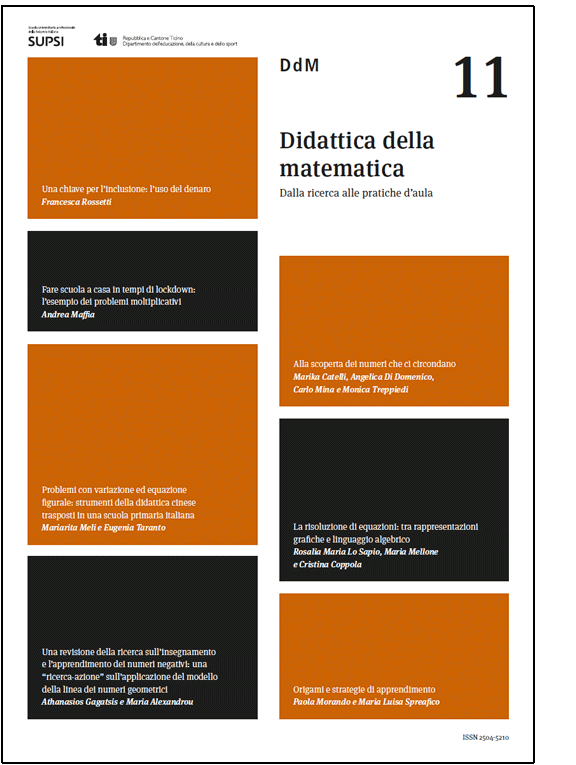
Downloads
Published
How to Cite
Issue
Section
License

This work is licensed under a Creative Commons Attribution 4.0 International License.