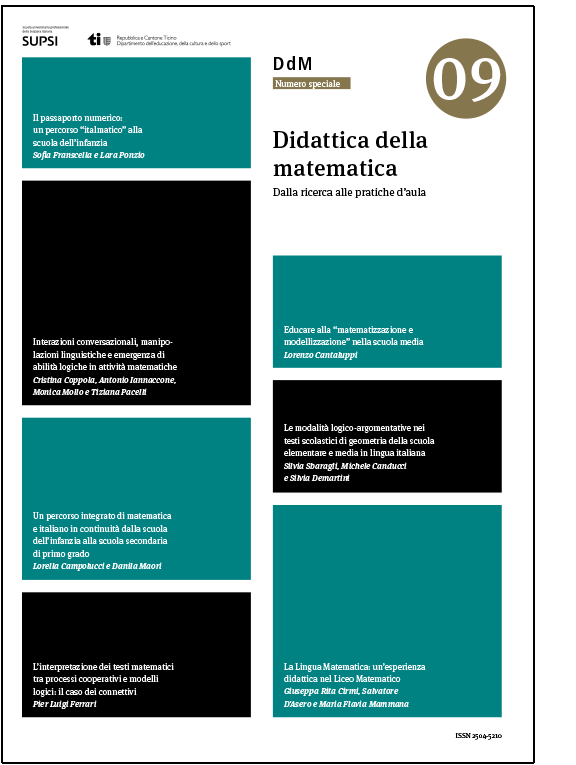
The interpretation of mathematical texts between cooperative processes and logical models: the case of connectives
DOI:
https://doi.org/10.33683/ddm.21.9.2Keywords:
language, logic, cooperative principles, connectives, biconditionalAbstract
The subject of the logical competency required to understand mathematics has almost always been the subject of educational controversies, between supporters of teaching logic as a subject and those who look at it as a transversal competency. The problem is often raised in upper secondary school and at the beginning of university courses. This paper discusses the processes of interpretation of mathematical texts in language, and the potential conflict between the mechanisms of interpretation of the symbolic notations of mathematics and the usual ones of languages. In particular, the topic of the interpretation of conditionals is addressed, also through the examination of two opposite theories. Some examples are then illustrated about other propositional connectives. The conclusion is that the diversity of interpretative processes between language and languages of logic does not recommend proposing activities that require the logical interpretation of verbal texts outside the contexts in which this is justified.
Downloads
Published
How to Cite
Issue
Section
License

This work is licensed under a Creative Commons Attribution 4.0 International License.