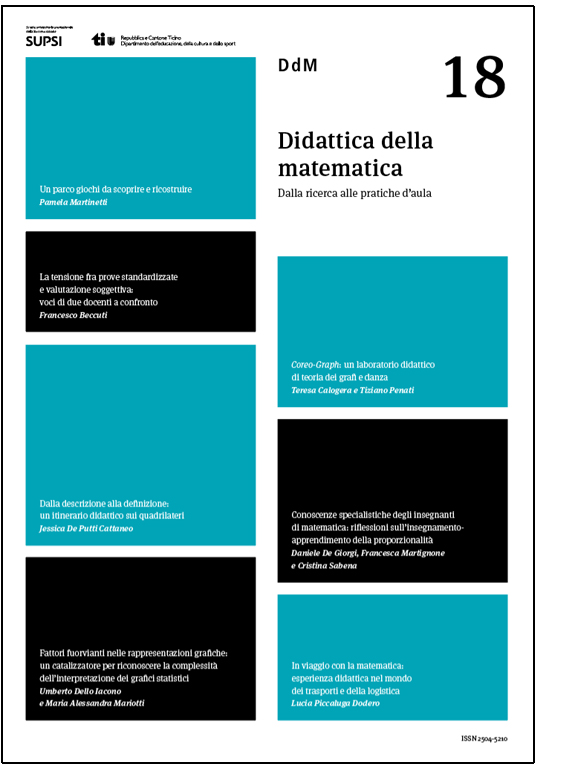
Coreo-Graph: a learning laboratory of graph-theory and dance
DOI:
https://doi.org/10.33683/ddm.24.18.4Keywords:
graph theory, dance, embodied cognition, problem solving, Königsberg’s problemAbstract
This contribution revisits a learning laboratory of graph theory, based on the well-known Königsberg’s bridges problem due to Euler, already proposed and described in Gaio et al. (2020): some of its conceptual aspects and laboratory activities are extended, in particular by inserting a dance-inspired activity in order to explore the properties of eulerian paths. In this new guise, the project was proposed and tested in the school years 22/23-23/24 as an activity to strengthen the curricular skills of problem solving. At the same time, it was an opportunity to think over the role of embodied activities in facilitating the formation of abstract concepts of mathematics.
Downloads
Published
How to Cite
Issue
Section
License

This work is licensed under a Creative Commons Attribution 4.0 International License.